After “World Ablaze,” Luiza Girardello Rediscovers the Power of Intimate Performance
Luiza Girardello’s debut album, “
World Ablaze,” is characterized by lush, full-band arrangements. But at an October 2 pocket show at Bibliotheque in SoHo, she rediscovered the power of stripped-down instrumentation and smaller, more intimate venues to strengthen the relationship between performer, song, and audience.
Several tracks on “World Ablaze” feature a string quartet. At Bibliotheque, her accompaniment was much simpler: She sang alongside a saxophone and a guitar.
“This was the first time I ever played in this setting with a saxophone,”
Girardello reflects. “I had played voice and guitar many times and featured a cello player on a few songs last year. But by virtue of how the instrument works, a cello player is able to play bass lines, as well, while a solo sax can only play melody lines.”
“Since we’re not playing arrangements, I didn’t write out specifically what notes he’s going to be playing,” she adds. “There’s more improvisation than on my usual shows with the band, where the arrangements are written out and contain specific moments of improvisation on them.”
Girardello is no stranger to live performance or improvisation. Since moving to Boston, she has played countless jazz and Brazilian music gigs, but performing her own songs as a solo artist is a different experience.
“Playing in intimate settings is something I’m really used to from my background of playing jazz and Brazilian music in places like restaurants and bars,” she says. “But in those kinds of settings, the musician is a bit more a part of the wallpaper than in a solo show. Speaking in between songs is still something I’m figuring out as a solo original artist.”
Girardello’s performance included a mix of original songs and covers. Her rendition of “Dê um Rolê,” a song by the Brazilian band Novos Baianos, was especially meaningful. The saxophone and guitar accompaniment leaned into the song’s natural bluesiness. And perhaps most importantly, Zabelê,
Girardello’s mentor and heir to the Novos Baianos tradition, was there in the room.
Girardello’s connection with Zabelê wasn’t the only creative relationship the performance highlighted. “The show revealed how much some partnerships add to the music. The Biblio show was the first time I played with [guitarist] Niko Malinowski after over a year,” she says. “Since the first time we ever played together for a Sofar Sounds show in Boston, it’s always clicked really well.”
The pocket show at Bibliotheque also offered a glimpse into
Girardello’s evolving approach to live music. Rather than treating intimate performances and full-band concerts as opposing formats, she is discovering how each can inform the other. The creative freedom of smaller ensembles has opened new possibilities for interpreting her existing repertoire, allowing familiar songs to take on different textures and emotional dimensions.
For Girardello, the October 2 show inspired reflection, gratitude, and even a slight shift in focus as she prepares for her next chapter as an artist.
“It rekindled my interest in playing in smaller instrumentation settings,” she says. “Since relocating to New York, I’d been so focused on getting back to performance shape with my full band that I think I forgot how nice and smooth playing in a smaller group can be.”
The experience has not diminished Girardello’s enthusiasm for full-band performances. Instead, it has encouraged her to reconsider how much structure a song needs to make an impact, and how spontaneity can become an equally important part of her musical expression.
“Maybe not every version has to have a very thoroughly written arrangement,” she muses. “With ‘Dê um Rolê,’ all I did was make a simple lead sheet and give it to the band, and it sounded great. So maybe less thinking and more action.”
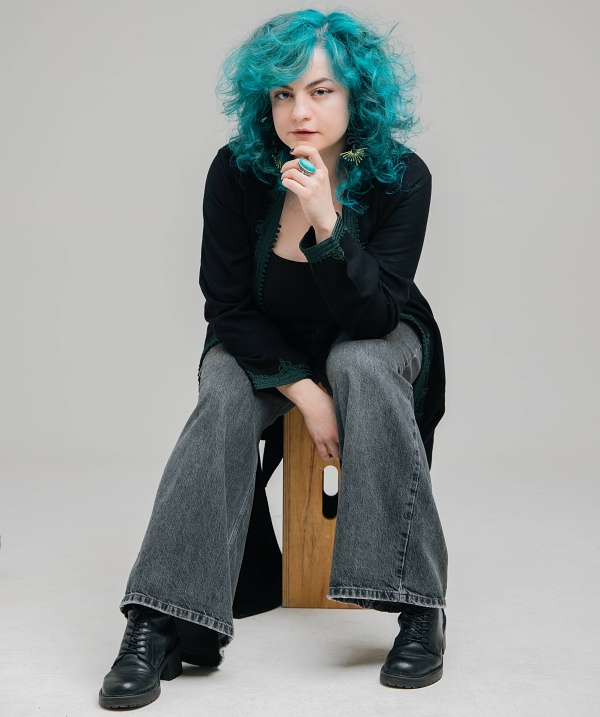
Photo credit: Gabriel Not