It's 2 a.m. You've just finished a track you're genuinely proud of. The synths sit right, the drop lands where it should, and for the first time in weeks, you feel ready to share what you've made. You upload it online, post the link to your story, and wait.
Nobody clicks. Nobody follows.
If you're making music these days, this scene is probably familiar. AI platforms like
Suno AI have made music production more accessible than ever, but getting people to actually pay attention to your work takes more than a great track alone. The platforms where music actually travels — TikTok, Instagram Reels, YouTube Shorts — are built for video. A great audio file, on its own, is nearly invisible to the algorithm. And that gap between "I made something good" and "people actually heard it" is where most independent music quietly disappears.
The Visual Layer Was Always the Hard PartFor artists backed by labels, the solution is straightforward: a budget, a director, and a production crew. For the independent majority, especially bedroom producers, songwriting beginners, and solo artists, the available options have long been limited. Static music visualizers may display a waveform, but they rarely reflect the structure, mood, or progression of the song. Basic audio-to-video converters focus on file generation rather than visual interpretation, while generic lyric video templates often remain disconnected from the music’s rhythm, energy, and emotional direction.
The result is a persistent imbalance: the music gets more sophisticated, but the way it's presented online often doesn't keep pace. For a generation of creators, the gap is more than an inconvenience.
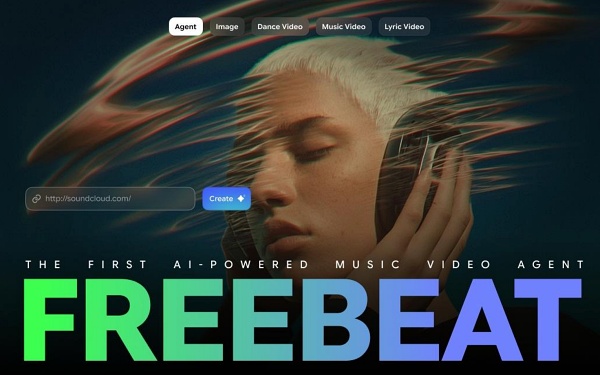
From Music Visualizer to Full Music Video: What Freebeat Actually Does Freebeat was the tool built to close exactly that gap— it goes considerably further than a traditional music visualizer or audio-to-video converter.
The core of what Freebeat does is deceptively straightforward: it listens to the song. The platform analyzes the actual audio, reading the BPM, the energy curve, and the structural shift between a verse and a chorus. From that analysis, it generates visuals that move with the rhythm and evolve with the architecture of the track — responding to the same moments a producer spent hours getting right.
See it in action:
What if one AI agent could turn your music into a full cinematic video in minutes?But the technical capabilities go further than beat-synced visuals alone.
Freebeat can generate a full-length music video of up to six minutes in a single export, covering an entire track from intro to outro without manual stitching. For creators working with vocal-driven tracks, Freebeat supports lip sync with around 90% accuracy, making it suitable for artist-focused videos where facial movement and performance presence are important. For songs involving multiple characters, such as duets, collaborations, or narrative-driven tracks with two protagonists, Freebeat also helps maintain dual-character consistency across scenes, ensuring a more coherent visual storyline from beginning to end.
For producers working with
Suno AI, this is especially relevant. Turning an AI-generated song into a complete, publishable music video traditionally requires a separate production workflow, including editing, visual planning, and post-production management. With Freebeat, the process is streamlined into a single upload-based workflow, reducing the need for manual editing timelines or additional production coordination.
Since launching, the platform has generated over one billion seconds of content for more than one million creators across 200+ countries, joined the Yamaha Creator Pass program, and been covered by USA Today for the way it's reshaping how Gen Z musicians share their work.
Freebeat has never positioned itself as a replacement for professional music video production. The platform was built for the majority: artists who have the songs but not the infrastructure to match.
Producing a beat-synced music video used to mean assembling a team. That equation has changed. For an independent artist working alone at 2 a.m., that is a meaningful shift — not just in workflow, but in what's possible.
About FreebeatBruce Chen is CEO and Co-founder of Freebeat (
freebeat.ai), an AI music video generation platform founded in 2024 by Stanford alumni. Freebeat is an official Yamaha Creator Pass partner.
YouTube I
TikTok I
Instagram