Introducing Onyx Halo: An AI Band Creation, Bringing a Songwriter’s Past Back to Life, and Into the Future.
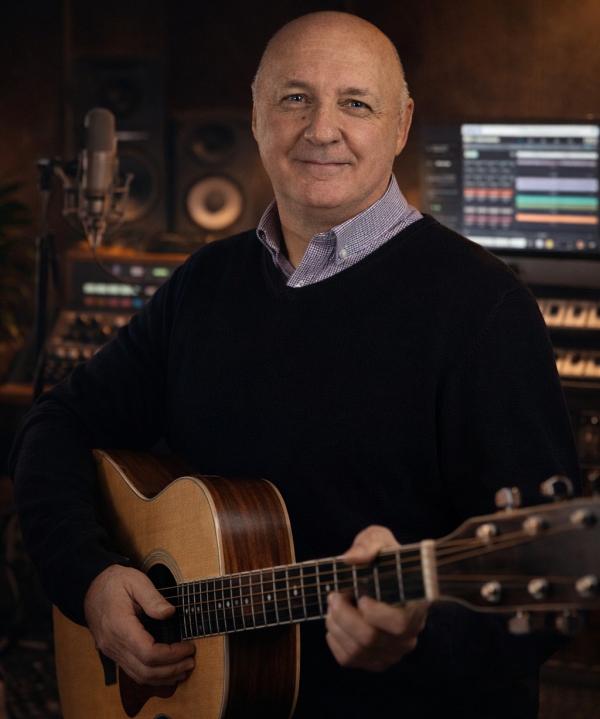
In 2026, after nearly three decades away from songwriting, Merseyside-born creator Stuart Hartley is stepping back into the music world with a project unlike anything he could have imagined in his early twenties. His new venture, Onyx Halo, is a fully AI-generated band, but the heart, the stories, and the songs are entirely his.
Between 1990 and 1995, Hartley lived for music. Armed with a home setup and a 4-track recorder, he wrote relentlessly, capturing raw, unfiltered demos and sending them to A&R departments with the kind of determination only youth and ambition can fuel. But professional recording was financially out of reach, and the industry’s rejections eventually pushed him toward a different path. By 25, he stepped away from songwriting and built a successful career as Managing Director of a manufacturing company: a future built on grit, stability, and long-term focus. Yet music has a way of waiting for the right moment.
In 2025, Hartley discovered emerging AI music technology and realised he could finally give his early songs the production they always deserved. He uploaded his original 4-track demos — some nearly 30 years old — and watched them evolve into fully produced, modern tracks that retained the emotional core of the originals. The process didn’t just revive old material; it reignited his creativity. Hartley began writing new songs again, blending the urgency of his early work with the perspective of a life fully lived.
To bring this new chapter to life visually and conceptually, he created Onyx Halo — an AI-powered band designed to embody the sound, the story, and the evolution of a songwriter returning to his craft.
Onyx Halo are fully Hartley’s creation too: a four-piece band who met at the Liverpool Institute for Performing Arts: a fictional origin story that reflects the spirit of the music rather than the literal process behind it. The band’s narrative is part of the project’s creative identity, but the music itself is entirely real: written by Hartley, produced with AI, and shaped by the emotional truth of his journey.
The band members are Art, Lee, Stone, and Jax - who each bring their own imagined histories, influences, and textures to the project. Art, the Toronto-born bassist with songwriter instincts and calm precision. Lee, the Dublin guitarist whose playing carries both fire and poetry. Stone, a Liverpool native with Jamaican roots, grounding the music in rhythm, groove, and heritage. Jax, from the Wirral, stitching everything together with rhythm guitar and harmonica, keeping the songs rooted when they threaten to drift skyward.
Onyx Halo began as a folk-rock act, but their sound naturally expands into rock, indie, blues, and cinematic atmospheres. They treat folk not as a genre but as a foundation — a heartbeat — while exploring whatever sonic territory feels right. In essence, the band are a ‘rebirth’, not a reinvention. They herald the return of a songwriter who never truly stopped being one, someone who carried unfinished music for decades and finally found the tools to finish the story.
The result is the album ‘Black Light’, released on 26th February 2026, a body of work that feels both nostalgic and new, grounded in the honesty of folk but unafraid to explore wider horizons. It’s a testament to what happens when old dreams meet new possibilities.
Listen to the album on Spotify
here.
Track Listing: (all original songs by Stuart Hartley)Side 1
1. In My World
2. Pressure Cooker
3. For Christ Sake
4. Streets Of Gold
5. You Think You Know
6. Only Dreaming
Side 2
1. Easy On Me
2. Face The World Alone
3. Promised Myself
4. Inside You
5. One World
6. When Will It End
Facebook I
SpotifyAfter nearly 30 years away from songwriting, what was the moment in 2025 that made you realise AI could finally bring your old demos back to life?I had started to feel the need to write again and started exploring how to record my demo’s as I knew cassette tapes was a thing of the past. Then I notice an old friend in America had released a single and she had posted about it on Facebook. Curious, I contacted her and she told me she’d done it with AI. She had such patience with me and told me how to do it for myself. I uploaded one of my old demo recording from 1992. I then prompted the software what I wanted the song to be like, instruments etc. The result was just amazing.
You spent the early ’90s writing relentlessly on a 4-track recorder. When you heard those songs re-imagined through AI for the first time, what emotions came up?I was in disbelief to be honest. It was like hearing the song I heard in my head finally got given life. It was exciting, it didn’t matter it wasn’t me performing. It was all about the song, it finally sounded like the song it was meant to be. I took the attitude if I had given the song to a new band who worked with a top producer, this would be the result. So, I embraced it, after all it’s a tool to make those songs come to life again after a long dusty sleep on cassette tape.
Many artists fear that AI might dilute authenticity, yet your project seems to do the opposite — it amplifies your original voice. How do you see AI as a creative partner rather than a replacement?AI is a tool, as a songwriter to helps me get the most out the song without having to compromise with session musicians and a producer, who all want to leave their mark on the recording. They are still my songs, but now they are in a format people can enjoy listening them, and if it helps the listener hear that, then AI has done its job. It doesn’t stop musicians doing their own thing or even covering the songs and adding their own uniqueness. What I’m basically saying is, it isn't going to replace anyone, it's just a tool to help people like me realise our creativity.
Onyx Halo has a fictional origin story, but the music is deeply personal. Why was it important to build a band narrative rather than release the songs under your own name?Firstly, because it’s not my performance, it’s an AI performance. I thought creating a brand for fans to follow is important. Then I thought about the Monkees from the 60’s a manufactured band that had a weekly episode on TV given a fictional story that captured a following. So I figured an AI band with social media stories would be the 21st century version of that, and it gives my music a platform.
 The four members of Onyx Halo — Art, Lee, Stone, and Jax — each have distinct personalities and musical identities. How did you shape these characters, and what do they represent within your own creative journey?
To be fair that’s still a work in progress. But I wanted to create a diverse group that came together to make a sound they all contribute too; it also allows me to follow different paths for the group as it evolves. I didn’t just want to create one path for the group. I needed to make it more open to tangents in their individual journeys.
Your early demos were born from youthful urgency, while your new material comes from a life fully lived. How do those two eras of songwriting meet on the album Black Light?Yes, there is only one brand new song on Black Light, called Pressure Cooker. Pressure has been earned over the years! But I have finished off a lot of unfinished songs from back then, so they are a true mix of old and new. You Think You Know and Inside You are two examples on Black Light that are a mix of old and new.
You walked away from music at 25 and built a successful career outside the industry. Looking back, do you feel the long break changed the way you write or understand your own work?I haven’t considered that; I always tried to write what I want to hear. I don’t feel my approach to music has changed, but maybe my attitude has. I’m less judgemental now.
Onyx Halo’s sound moves between folk, rock, indie, blues, and cinematic textures. Was that fluidity intentional, or did it emerge naturally once you started producing with AI?Folk Rock is basically what I used to write, but occasionally I tried to write songs that had a feel of songs I loved to listen to, influences I guess. AI helped me achieve that easier. It I wanted a more psychedelic feel; I could just prompt the AI to add that feel to the music. One World on the album was done that way.
There’s a strong theme of “rebirth” in this project. Do you see Black Light as closing a chapter, opening a new one, or perhaps reconnecting two halves of the same story?That’s a big question. An honest answer: I think I see it as a second chance for these songs. It all about the songs and not me. I’m finding it exciting and very rewarding.
Now that you’ve returned to songwriting with new tools and a new perspective, what do you hope listeners take away from Onyx Halo — and from your own journey back to music?I’m hoping they like it and want to listen to the music, I’d be the happiest man alive if some real (human) musicians decided they wanted to make one of the songs their own. Then the music can lift to another level and evolve further.